Category: Blog

Your blog category

  • Why your design needs a plot? The UX storyteller

    Why your design needs a plot? The UX storyteller

    When I first started my journey into User Experience design, I was intoxicated by the Discovery phase. I loved the detective work: digging into business goals, interviewing users, sketching out empathy maps, and debating user journeys. There is a specific kind of magic in seeing the world through someone else’s eyes and collaborating with peers, mentors, and stakeholders to find that “perfect” solution.

    But as I progressed, I realized I was missing a vital tool in my kit. I had the data, the research, and the wireframes, but I didn’t yet have the art of storytelling. I didn’t realize that the order in which we tell a story, and the clarity of that story, is what transforms a “product” into an “experience.”

    To understand why storytelling is so critical in UX, we have to look at the philosophy of art.

    The designer’s dilemma: art vs. utility

    In traditional European art, there is a focus on objective realism. The artist has a precise, fixed meaning they want to convey. The intent is often to capture a specific moment or truth, leaving little room for the viewer to guess what they are looking at.

    Conversely, traditional Chinese art often emphasizes an open-ended experience. It’s designed for the viewer’s spiritual participation, a subjective interpretation where the viewer “enters” the landscape and finds their own meaning.

    As designers, we might be tempted to lean toward the “open-ended” side, but in UX, subjectivity is the enemy. If a user has to “interpret” what a button does or “participate spiritually” to find the navigation menu, the design has failed. We must be like the European masters of intent: our story must be precise, directional, and impossible to misinterpret. We aren’t just making something pretty; we are telling the user exactly where to go next.

    Why sequence is everything: the hare and the tortoise

    We all know the story of The Tortoise and the Hare. Its power lies in its sequence:

    The Resolution: The Tortoise wins.

    The Challenge: The Race.

    The Conflict: The Hare’s arrogance.

    The Pivot: The Nap.

    Imagine if we changed the order. What if the story started with the Tortoise winning, then showed the race, and ended with the Hare taking a nap? The moral is lost. The emotional payoff is gone. It becomes just a series of random events. In UX, User Flows are our sequences. If we ask a user to “Sign Up” (Resolution) before they understand the “Value Proposition” (The Setup), we are telling the story out of order. A great UX story builds tension by identifying a problem and releases it by providing a solution.

    The narrative structure of a user journey

    Every good project follows a narrative arc. When you look at a user journey, you aren’t just looking at steps; you’re looking at a plot:

    • The Hero: The User.
    • The Goal: What they want to achieve.
    • The Villain: The pain points, the friction, and the “bad design” they currently face.
    • The Mentor: Your product or solution that gives them the tools to win.

    By framing our designs this way, we do more than just “fix bugs.” We create a transformation.

    Storytelling as your stakeholder superpower

    This narrative approach is also the secret to Stakeholder Buy-in.

    If I show a room of executives a spreadsheet of user pain points, they see “data.” If I tell them the story of “Aarav,” a small business owner who lost three customers today because our checkout page timed out, they see a mission.

    Storytelling is the “Trojan Horse” of UX. It allows us to humanize complex data and align everyone, from developers to CEOs, on a single, clear vision. It moves the conversation from “I don’t like this color” to “How does this help our hero reach the finish line?”

    The “micro-story” in the UI

    Finally, storytelling lives in the details. We call these Micro-stories.

    It’s in the microcopy on a button that says “Let’s go!” instead of “Submit.” It’s in the loading animation that tells the user the app is working hard for them, not just lagging. It’s the success message that celebrates a completed task. These tiny moments are the “happily ever afters” of the digital world, making the user feel seen and supported.

    Everything is a story

    Whether I’m drawing an empathy map or presenting a high-fidelity prototype, I’ve learned that everything we do as designers requires storytelling to be relevant. Without a story, design is just pixels. With a story, design is a bridge between a human need and a digital solution.

    At the end of the day, my job is to make sure that when the user enters the “race,” they know exactly how to win.


  • Bad onboarding, not bad ingredients: what food habits taught me about UX, expectations, and trust

    Bad onboarding, not bad ingredients: what food habits taught me about UX, expectations, and trust

    We live in a world where food fills more than our plates, it fills our feeds. Scroll through Instagram or YouTube long enough, and you’ll find yourself craving things you’ve never tasted before. That glossy pistachio dessert, the perfectly swirled bowl of ramen, or that creamy green spread on toast catches your eye. You don’t know how it tastes yet, but seeing it repeatedly convinces you that you’ll like it.

    Desire today is often visually crafted well before our senses experience it.

    My first “broken experience” with avocado

    I remember the first time I tried avocado back in 2018. I was genuinely excited. It looked fresh, tangy, and slightly sweet somewhere in my mind, I compared it to raw mango. But when I tasted it, the reality was quite different: neutral, creamy, almost blank.

    I didn’t question the preparation. I simply concluded, “I don’t like avocado.” But this wasn’t about the food itself. It was a failed product experience.


    From a UX perspective:

    • Visual design (UI): Highly appealing, aspirational
    • Mental model: “This will taste tangy and fresh”
    • Actual experience: Neutral, unfamiliar
    • Outcome: User churn

    In simple terms, it was a classic case of mismatched expectations, poor onboarding, and no opportunity to recover.

    Why so many people “hate” vegetables

    This pattern repeats often. Most people don’t hate vegetables, they hate their first experience with them. Think about common childhood memories: overcooked beans, bitter karela without balance, or plain boiled vegetables.


    What’s really happening is broken onboarding. When the first experience fails, users seldom retry. Biases become locked in, and avoidance turns into identity. Saying “I don’t eat vegetables” often just means “I had a bad first version of them.”

    The fish sauce paradox

    When I first used fish sauce, its smell almost made me quit. It was strong, unfamiliar, and not immediately appetizing. But I stuck with the recipe. The final dish? Rich, balanced, deeply satisfying.


    The UX insight here is this: some components aren’t meant to be experienced in isolation. They are context-dependent, system-dependent, and part of a larger interaction. Yet, our brains often judge them too early.

    The “hack” that works, but breaks trust

    A common tactic to get people to eat disliked foods is to hide or disguise the ingredient pumpkin in mayo, spinach in pasta, beetroot in desserts. It works. People enjoy the dish.


    But when they find out later, the reaction is often, “Why didn’t you tell me?” What could have been a discovery turns into deception. In UX, short-term conversion at the cost of trust is a bad trade.

    Designing better “food experiences”

    If we treat food like product design, the goal isn’t to trick users. It’s to design onboarding that sets clear expectations:


    1. 1. Align the mental model:  Set honest expectations (“This doesn’t taste like typical pumpkin.”)
    2. 2. Improve the first-use experience:  Better seasoning, texture, and context.
    3. 3. Use familiar bridges:  Introduce new ingredients through known formats.
    4. 4. Preserve user agency: People are more open when they feel in control.

    The avocado redemption

    Years later, I tried avocado again, this time with salt, lemon, and in the right context. Suddenly, it worked. Not because the avocado changed, but because the experience was finally designed well.

    UX Reality

    This pattern extends beyond food. Take something like filling out an insurance form or applying for a job online. A long, complicated form immediately shapes negative expectations. It feels overwhelming even before a user starts. If the onboarding experience is heavy or poorly designed, users drop off.

    But breaking the process into smaller steps, guiding users with context, and building confidence gradually changes everything. When onboarding feels manageable, users are far more likely to continue.

    Maybe we don’t hate certain foods or tasks. Maybe we just experienced them through bad onboarding, broken expectations, or misplaced context. And maybe the real question is:

    How many things in life have we rejected not because they were bad, but because they were badly introduced?

  • When ads work too well but UX breaks the promise

    When ads work too well but UX breaks the promise

    Hey there! Today I want to talk about something many of us have experienced but seldom pause to think about, the moment an ad grabs your attention, but the user experience that follows doesn’t quite live up to that initial spark.

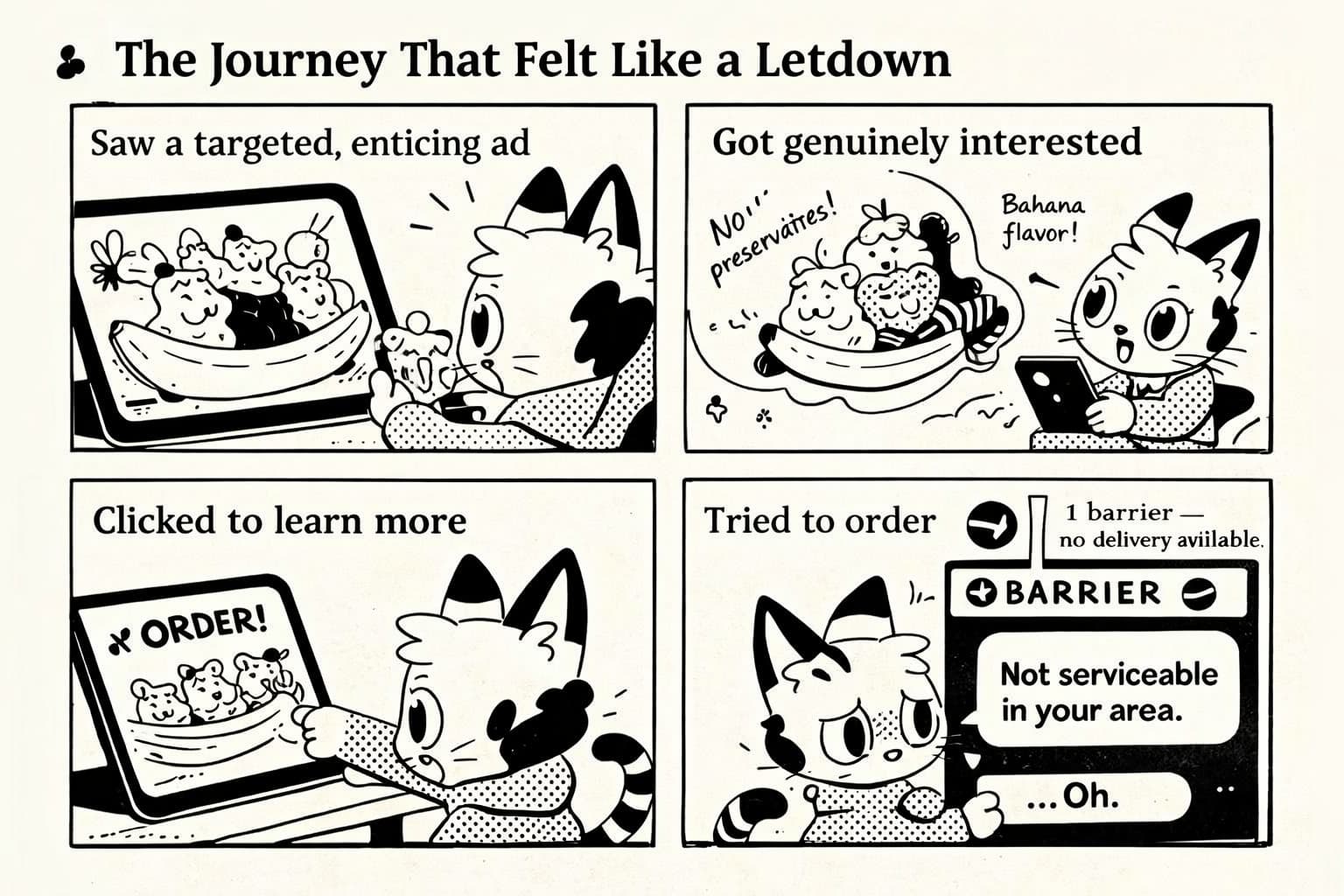
    Recently, I found myself hooked by a simple Instagram ad for banana-flavored ice cream. Real fruits, real milk, no preservatives. That banana flavor was a rarity and immediately piqued my curiosity. I went from casual scrolling to genuine excitement in seconds, clicked through, and started exploring the options. But when I tried to place an order, the crushing message appeared: “Not serviceable in your area.” My craving was met with a dead end.

    The product didn’t fail, the experience did

    The product itself was spot on. The ad created interest, made me want to try something new. But the experience that followed felt like a broken promise. The excitement generated by the ad wasn’t matched by a clear pathway to actually enjoy the product. This is a classic clash where marketing and user experience fail to align.

    Why This Experience Stings More Than It Should? Food cravings are often impulsive. When you see something appealing, you want it immediately. The ad did its job perfectly by creating desire. But the delay in revealing the constraints shattered the momentum. It left a gap between expectation and reality and that gap is where frustration lives. It’s disappointing because it colors how I see the brand. Not as careless on purpose, but as someone who didn’t fully think through what it means to truly serve me as a user.

    blog2Image1

    Three main problems crop up in these scenarios:

    • Targeting Without Full Context
      Ads hit the right audience but ignore constraints like location or inventory.
    • Late Discovery of Limits
      Key details like service area or stock status appear too late, after the user has already engaged.
    • No Plan B or Recovery
      When the offer isn’t actually available, there is no effort to keep the customer interested or suggest alternatives.

    This happens beyond food too

    • A stunning sofa ad that only ships to select cities
    • A fashion promo where your size is sold out
    • An app full of promise but not available in your country

    How to make this experience better

    Small but thoughtful changes can save the day:

    • Set Clear Expectations from the Start
      Show upfront if a product or service is limited by location or availability.
    • Check Availability Early
      Use location or zip code info before users dive deep, so they aren’t wasting time.
    • Turn a No Into a Maybe
      If the product isn’t available, offer to notify the customer when it is, invite them onto a waitlist, or suggest nearby pick up options.

    Aligning attention with fulfillment

    This story isn’t just about ice cream. It highlights a common disconnect between marketing and UX. Advertising aims to capture interest and clicks. UX is about guiding users successfully through an experience that builds trust. When these two aren’t in sync, the gaps don’t just cause drop-off. This creates a negative brand memory.

    Great ads get us excited, but great user experiences deliver on that excitement. When there’s a mismatch, users don’t just walk away they feel let down. As designers and creators, our responsibility is clear: if we promise something, we must make it genuinely accessible and enjoyable. Because once a user feels disappointed, no product, however good, will easily win them back.. 


    Thanks for reading. If you’ve ever stumbled across an experience like this, I’d love to hear your story. I’ll be sharing tips on designing for honest communication in digital products soon, something I believe can change moments like these for the better. Until then, keep questioning what promises you make and how you make them real.

  • How to win RFPs without welling your UX soul

    How to win RFPs without welling your UX soul

    RFPs are sales artifacts, not product briefs. Here’s a practical way to respond that protects design craft, helps sales win, and reduces downstream rework.

    If you’ve worked at a small or mid-size design firm, the RFP treadmill will feel familiar: rushed timelines, endless requirement lists, and an expectation to design an entire website before anyone agrees on the problem.


    My perspective on this comes from an unusual career path. I started in retail, where storytelling, perception, and confidence drive decisions. Later, I moved into UX and product design, where progress depends on research, validation, and embracing uncertainty.


    RFPs force these two worlds to collide. They reward certainty over learning and visuals over validation. The result? Projects that look great on paper but drift the moment real constraints surface, leaving teams exhausted and designers questioning the value of their work. This article is an attempt to bridge those two worlds without burning teams or compromising design integrity.

    Quick reality check

    Design doesn’t exist to make pretty screens; it exists to reduce the risk of building the wrong thing. That’s why investing in design capability matters. According to McKinsey & Company’s The Business Value of Design study, companies in the top quartile of the McKinsey Design Index saw 32 % higher revenue growth and 56 % higher total returns to shareholders over five years compared with industry peers and this was consistent across multiple industries. 

    On the digital maturity side, Boston Consulting Group’s Digital Acceleration Index found that the most digitally mature companies saw valuations ~23 % above pre-crisis levels within six months of the pandemic’s start and outperformed peers across key performance metrics including revenue growth and enterprise value. 


    In other words, firms that integrate design and early validation into strategy rather than just shipping screens tend to see measurable financial advantages and resilience in uncertain markets.

    (Translation: good discovery + realistic RFPs = less waste + higher returns.)

    Why RFPs often demand full designs

    1. 1. Visuals are the easiest way to compare vendors
      RFPs are often driven by procurement or IT teams who need clear, comparable evaluation criteria. Screens are tangible and easy to judge side by side, so polished designs become a stand-in for capability even when the problem itself is still evolving.
    2. 2. Design maturity varies across organizations
      In many companies, design has traditionally been seen as an execution step rather than a discovery process. Without a shared language for uncertainty and validation, it’s natural to ask for finished-looking outputs early instead of open-ended exploration.
    3. 3. Pressure to show progress and win quickly
      RFPs are frequently used to align internal stakeholders, and sales teams operate under tight timelines. In both cases, visuals become the fastest way to signal momentum and value, even if they’re meant to be directional rather than final.

    Why this breaks down

    Together, these forces push teams to show certainty before learning rewarding completeness over correctness and setting projects up for rework once real constraints emerge.

    The damage

    • Teams burn time on speculative work that never lands in product.
    • Designs get repurposed unquestioned into implementation (technical debt).
    • Designers feel demotivated and labelled “inefficient” when bids fail.
    • Rework explodes: industry studies across projects show rework is a large hidden cost when requirements and assumptions aren’t validated early. (Rework rates vary by domain but are frequently large enough to justify paid discovery phases.) 

    Principles: Responding to RFPs without killing UX integrity

    1. 1. You’re selling confidence, not final pixels.
      Clients are buying the belief that you won’t embarrass them internally and will deliver results.
    2. 2. Use their language.
      Replace UX jargon with business outcomes: “reduce rework,” “validate assumptions,” “shorten time to revenue.”
    3. 3. Show just enough design—signal thinking, don’t promise delivery.
      One core scenario, mid-fidelity wireframes, and annotated intent beats ten high-fidelity screens.
    4. 4. Make assumptions and validation explicit.
      List the assumptions you’re making and exactly what you’ll validate during discovery.

    Protect your team’s morale

    Propose a short internal policy (email or one-pager) your head of design or delivery can adopt. This pact changes incentives and reduces the narrative “design is slow/inefficient.”

    • RFP effort capped at X hours per designer.
    • Design deliverables labelled “conceptual.”
    • No re-use of RFP deliverables as production artifacts without paid rework.
    • Sales must include a standard “discovery” line-item in proposals; if client declines, the team will supply a scoped concept with explicit risk disclosures.
    • Leadership will not evaluate designers on win rate.

    “Show one scenario well.
    Don’t show ten pages you’ll later abandon.”

    Closing: a practical, not preachy, ask to clients

    IRFPs sit at the intersection of two very real needs: the need to sell confidence and the need to discover the right solution. When we treat them purely as sales documents, design becomes performative. When we treat them purely as product briefs, we ignore the realities of how buying decisions are made.

    The work, then, isn’t to eliminate RFPs or resist visuals but to use them more honestly. To show thinking without pretending certainty, to signal capability without overpromising, and to protect teams from doing work that was never meant to be final. When RFPs are handled this way, they stop being a drain on design integrity and start becoming what they should have been all along: the beginning of a better conversation.

    Appendix

    Tactical recipe you can execute in 2–4 days (what to include in the RFP response)

    • One-page problem statement (their words + your concise reframe)
      Call out the biggest risk(s).
    • Our approach (Discovery → Design → Validate → Deliver)
      with estimated weeks and outcomes for Phase 1.
    • Weeks 1–3: Discovery (users, content, tech constraints)
      deliverables: 3 validated user journeys + IA recommendations
    • Weeks 4–7: Design iteration (mid→hi fidelity prototypes)
      deliverables: clickable prototype, UI kit
    • Weeks 8–12: Validation & handoff
      deliverables: QA checklist, dev-ready assets
    • Design sample
      One primary scenario with 3–5 annotated screens (mid fidelity) and 2–3 measurable success metrics.
      Label it as ‘Conceptual’.
    • Assumptions
      List 3 major assumptions and “what we’ll validate in discovery.
    • Team & past work
      1 short case study which is result-focused
    • Next step
      “We recommend starting with a 2–3 week paid discovery to validate assumptions and reduce rework.”